Gallery
Prints of the Edo police
Kabuki and storytelling prints often showed police officers at the moment of arrest — a jutte raised, a suspect cornered on a rooftop. These five prints from Dr. Cunningham’s collection are shown with the notes he published beside them. The prints are nineteenth-century works; the photographs are his.Source A11Source A13Source A9
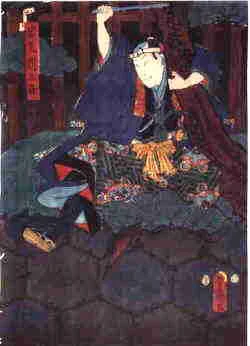
01
Iwami Shinsaburo
This doshin is wearing a typical Edo Period (1600-1868) costume of a Japanese policeman. Note the jutte (iron truncheon) that he raises above his head in his right hand. An original Japanese woodblock print, Iwami Shinsaburo, by Toyokuni, 19th century. Dimensions: 10 x 14 inches. Impression: Excellent. Condition: Very Good. A few worm-holes in line with left edge and lined by Japanese paper.Source A11
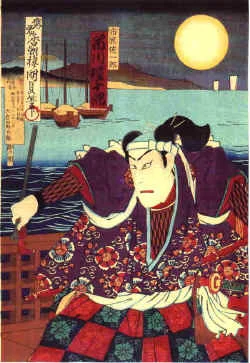
02
Ichikawa Gonjuro
A doshin patrolling along the docks of Edo. Note the jutte (iron truncheon) that he carries in his right hand and the small fishing boats anchored just off shore. An original Japanese woodblock print, Ichikawa Gonjuro, by Kunisada. Signatures and Seals: Signed by Kunisada. The publisher is Shirobei Okura from the Kanda District. The date is Meiji 22. Dimensions: 10 x 14 inches. Impression: Excellent. Condition: Very Good. The artist, Kunisada, is considered one of the most famous 19th century Nishiki-e painters for woodblock prints.Source A11
Note. Meiji 22 corresponds to 1889, decades after the 1825 Kunisada diptych shown below. The attribution and date are reproduced as published and should be checked against a print catalogue.
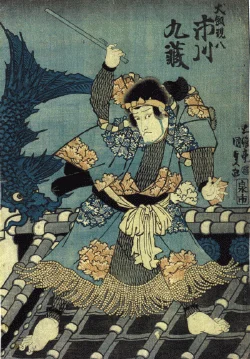
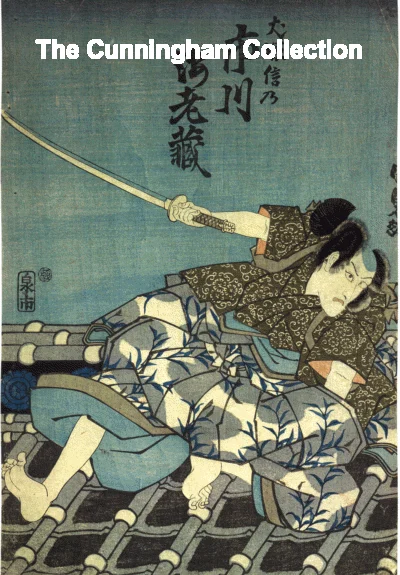
03
Hakkenden: the rooftop fight (diptych)
The diptych illustrates the famous rooftop fight scene between Inuzuka, the free-spirited rebel (right), and Inutsuna, a police officer sent to capture him (left). At this moment of the fight, Inazuka is fighting for control on the slippery temple rooftop, while Inatsuna raises his jutte (iron truncheon) to strike. Beside him is a huge roof ornament, a giant dragon fish whose open mouth seems to be biting down on the crossbeam. Two original Japanese woodblock prints by Utagawa Kunisada I, diptych printed in 1825. Signatures and Seals: Signed by Gototei Kunisada." The publisher is Sen-Ichi. There is a kiwame seal (used 1790-1840). Dimensions: 19 x 14 inches, total. Impression: Excellent. Condition: Good-Very Good. Binding holes, backed with old Japanese calligraphy paper, creased and reinforced corners.Source A13
04
Inazuka Shiro
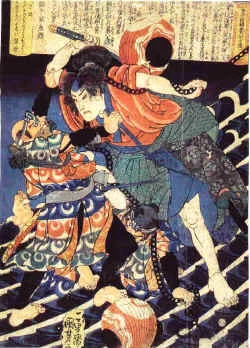
Another view of two police officers attempting to arrest Inazuka, the free-spirited rebel, on the temple rooftop. One officer confronts Inazuka with a jutte (iron truncheon) in his right hand while blocking Inazuka's sword strike with his left hand on his elbow. Another officer wraps the dog warrior in chains before slipping and falling on the roof tiles. An original Japanese woodblock print, Inazuka Shiro, by Ichiyusai Kunitoshi, printed in the 1830s. Dimensions: 10 x 14 inches. Impression: Excellent. Condition: Excellent.Source A13
05
Chushingura
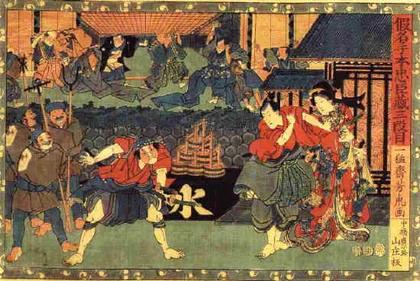
In the foreground, the police are dispatched to arrest Lord Asano, while in the background, the attack on Kira while in the shogun's castle is depicted. Three komono (non-samurai police assistants) on the left are carrying torimono sandogu the three main arresting tools, the sodegurame (sleeve entangler), the tsukubo (a T-shaped polearm), and the sasumata (a U-shaped polearm). An original Japanese woodblock print, Chushingura, by Yoshitara, printed in 1852. Dimensions: 14 x 10 inches. Impression: Very Good Condition: Very Good.Source A9
Two further prints described on the same pages — hand-numbered reproductions of Hokushu’s Torite (c. 1822) — were not preserved in the web archive and cannot be shown.Source A11
Sources for this page
- A9D. Cunningham, woodblock notes: “Chushingura”. e-budokai.com/woodblock/chushingura.htm · capture 2009-01-11 · Original organizational material
- A11D. Cunningham, woodblock notes: “Doshin”. e-budokai.com/woodblock/doshin.htm · capture 2009-01-11 · Original organizational material
- A13D. Cunningham, woodblock notes: “Hakkenden”. e-budokai.com/woodblock/hakkenden.htm · capture 2009-01-11 · Original organizational material
- D36Owner’s confirmation of permission to republish the organization’s and Dr. Cunningham’s texts, photographs and graphics. project record, docs/rights-and-attribution.md · 2026-11-03 · Owner-supplied file