Chapter · Policing Edo
Taken alive.
Edo was a crowded city of samurai, merchants, craftsmen and labourers. Minor quarrels in an armed population could turn violent, and the shogunate’s official police were few. Officers and their assistants developed weapons and techniques to arrest suspects who were usually armed and often desperate — without killing them.Source A18Source A24
Edo
The shogun’s city
After unifying Japan’s feudal domains, Tokugawa Ieyasu based his government in Edo, the site of present-day Tokyo. The city drew labourers, craftsmen and merchants, and a large samurai population. To keep order, the shogunate devised an elaborate police system — small for the size of the city, so the patrols often filled their ranks with townsmen and even former criminals.Source A24
町奉行machi-bugyō
The magistrates
Two machi-bugyō headed the system, each a combination of town magistrate, judge and police chief. Their office ran a full range of civil administration and a judicial system for non-samurai. Samurai themselves answered to separate investigators, and temples and shrines to the jisha-bugyō.Source A24
与力yoriki
The assistant magistrates
Yoriki handled day-to-day affairs and general police duties. As samurai they ranked far above the townspeople they dealt with, yet their peers shunned them for their connection with executions — they were barred even from entering the castle. In hakama, haori and two swords, they directed the dōshin.Source A24
同心dōshin
The three patrols
Patrols were carried out by low-grade samurai called dōshin, distinguished by a single sword and tight trousers. Two patrols worked openly, the jutte — badge of their office — on display. The third investigated in disguise.Source A24Source A11
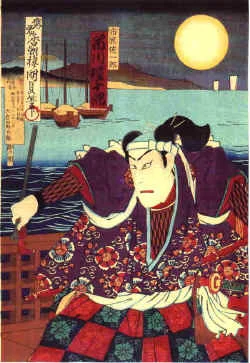
Ichikawa Gonjuro, attributed by the source to Kunisada; dated Meiji 22Source A11 小者 · 岡引komono · goyōkiki · okappiki
Assistants and informants
Each dōshin patrolled with non-samurai followers: full-time komono and part-time goyōkiki who also carried a jutte as a symbol of authority. Dōshin privately employed okappiki too — usually former criminals drafted as informants. The authorities discouraged them; the growing city made them a practical necessity.Source A24
keisatsu-jutsu
Taken alive
The goal was to capture lawbreakers alive and without injury. Methods drawn from classical swordsmanship and jujutsu were adapted with specialized implements meant to disarm and restrain rather than kill — the jutte above all, and for dangerous arrests the long “three tools” that held a suspect at a distance.Source A24Source B1

J-23, uchiharai jutte, Cunningham collection. Copyright © 2009. Photograph by Don Cunningham.Source A17 Catalogue record
The arresting arts
What the police practised
According to the organization’s curriculum page, Edo law-enforcement officers trained mainly in the unarmed methods of jujutsu, and developed non-lethal implements for capturing and restraining suspects — among them jutte-jutsu and toritejutsu, both of which appear in the eighteen classical branches of Japanese martial arts, the Bugei Ju-Happan.Source A10
The same page traces a modern line: the Tokyo police adopted judo after an 1886 contest between the Kodokan and older jujutsu schools, and a Kodokan working group added Goshin Jutsu self-defence forms in 1956.Source A10
These lists are reproduced as the organization presented them. They describe EMKTJ’s understanding of the arresting arts, not a verified historical syllabus.
Unarmed forms
- Tai sabaki body movement
- Uke waza receiving techniques
- Atemi waza striking techniques
- Te hodoki waza escaping techniques
- Osae waza restraining and holding techniques
- Kansetsu waza joint-locking techniques
- Nage waza throwing techniques
- Shime waza choking techniques
Armed forms
- Jutte jutsu truncheon
- Tessen jutsu iron fan
- Hojo-jutsu cord binding
Contemporary forms
- Tokushu keibo-jutsu telescopic baton
- Tekase-jutsu handcuffing techniques
- Hiki-tate methods for standing an arrested suspect
- Kaeshi-waza reversal techniques
- Tanju hoji waza handgun retention techniques
SourceSource A10
Implements
Tools of arrest
- jutte十手
- Iron truncheon. It could parry a sword and help disarm a suspect without serious injury, and in time became a badge of office carried by all levels of police.Source A18Source A17
- tessen
- Iron fan.Source A7
- torimono sandōgu
- “Three tools of arresting”: long pole arms — sodegarami, sasumata and tsukubō — used to hold a suspect at a safe distance.Source B1
- tsukubō
- Push pole; a T-shaped pole arm.Source B1
- torinawa
- Arresting rope. Cunningham’s collection includes an Edo-period hand-woven hemp torinawa once wrapped around the handle of a solid tessen.Source A7Source A27
- shikomi-sensu
- A dagger hidden in a mounting made to appear as a closed fan — described by Cunningham as a favourite weapon of assassins, gamblers and other criminals.Source A27
See objects from the Cunningham collection · Glossary of terms
Sources for this page
- B1M. Street, review of Taiho-Jutsu, The Asian Reporter. asianreporter.com · 2004 · Independent source
- A7Book page, Taiho-Jutsu: Law and Order in the Age of the Samurai. e-budokai.com/books/taiho.htm · updated 2010-10-19 (capture 2013-05-21) · Original organizational material
- A10Edo Machi-kata Taiho Jutsu, “Arresting Arts”. e-budokai.com/curriculum/index.htm · updated 2010-09-09 (capture 2013-10-01) · Original organizational material
- A11D. Cunningham, woodblock notes: “Doshin”. e-budokai.com/woodblock/doshin.htm · capture 2009-01-11 · Original organizational material
- A17Cunningham collection, “Jutte (2)”. e-budokai.com/weapons/jutte2.htm · © 2009 (capture 2013-08-06) · Original organizational material
- A18D. Cunningham, “Jutte”. e-budokai.com/hibuki/jutte.htm · capture 2009-01-08 · Original organizational material
- A24D. Cunningham, “Samurai police”. e-budokai.com/hibuki/police.htm · © 2002 Budo Kai, Ltd; updated 2005-03-18 (capture 2009-01-10) · Original organizational material
- A27Cunningham collection, “Tessen”. e-budokai.com/weapons/tessen.htm · © 2009 (capture 2013-07-02) · Original organizational material
- B33P. Powers, “Author lays down law on historical Japanese weapons”, Leader-Telegram (Eau Claire, WI). scan at e-budokai.com/books/leader1-bw.pdf · 2006-01-12 · Independent source