Edo Machi-kata Taiho Jutsu江戸町形逮捕術

The Cunningham collection · P-1–P-3

Pole arms

The feudal police often relied on various pole arm arresting implements that could be used from a relatively safe distance to restrain and disarm suspects. Copyright © 2009. Please do not use the photographs or the text on this site without permission. (Image use must include the statement: "Copyright © 2009. Photograph by Don Cunningham.")

— Don Cunningham, introduction to the catalogue pageSource A23

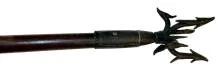
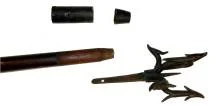
Pole arm, catalogue number P-1, view 1 of 3 from the Cunningham collectionPole arm, catalogue number P-1, view 2 of 3 from the Cunningham collectionPole arm, catalogue number P-1, view 3 of 3 from the Cunningham collection

P-1

Pole arm

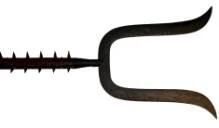
This is a late Edo-period sasumata. This U-shaped pole arm was used to trap the neck or limbs to immobilize an opponent. One of the of the standard Edo-period police station tools called torimono sandogu (three tools of arresting), the U-shaped end was used to trap an opponent. Then the person could be pushed to a wall or other barrier and immobilized. The other two long pole arresting implements were the sodegarami, which had short spikes used to ensnare the clothing, and the tsukubo, which had a T-shaped end used to push and control an opponent.Source A23

Catalogue text and photographs by Don Cunningham. Copyright © 2009. Photograph by Don Cunningham.

Archived catalogue page · Link to this object

Pole arm, catalogue number P-2, view 1 of 3 from the Cunningham collectionPole arm, catalogue number P-2, view 2 of 3 from the Cunningham collectionPole arm, catalogue number P-2, view 3 of 3 from the Cunningham collection

P-2

Pole arm

This is a late Edo-period sodegarami (sleeve entangler). This pole arm arresting implement was the most frequently used of the standard Edo-period police station tools called torimono sandogu (three tools of arresting). The short spikes were thrust into an offender's kimono or other clothing with a twisting action to entangle the material. Then the person could be pushed to the ground and immobilized. The other two long pole arresting implements were the sasumata, which had a U-shaped end used to pin the neck or limbs, and the tsukubo, which had a T-shaped end used to push and control an opponent.Source A23

Catalogue text and photographs by Don Cunningham. Copyright © 2009. Photograph by Don Cunningham.

Archived catalogue page · Link to this object

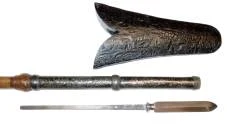
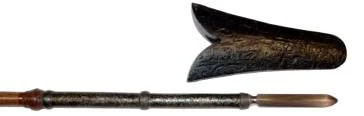
Pole arm, catalogue number P-3, view 1 of 4 from the Cunningham collectionPole arm, catalogue number P-3, view 2 of 4 from the Cunningham collectionPole arm, catalogue number P-3, view 3 of 4 from the Cunningham collectionPole arm, catalogue number P-3, view 4 of 4 from the Cunningham collection

P-3

Pole arm

This is a late Edo-period or early Meiji-era teyari (hand spear). Shorter than a typical yari, the teyari was often the favored weapon of the machi-kata yoriki for apprehending lawbreakers, especially in confined spaces.Source A23

Catalogue text and photographs by Don Cunningham. Copyright © 2009. Photograph by Don Cunningham.

Archived catalogue page · Link to this object

Sources for this page

  1. A23Cunningham collection, “Pole arms”. e-budokai.com/weapons/polearms.htm · © 2009 (capture 2013-01-03) · Original organizational material
  2. D36Owner’s confirmation of permission to republish the organization’s and Dr. Cunningham’s texts, photographs and graphics. project record, docs/rights-and-attribution.md · 2026-11-03 · Owner-supplied file

Full source register and method